Friday, June 23, 2006
Diving Disney
You're looking at a Christmas present that is six months overdue to be enjoyed. Tomorrow night, I'll (finally) get to go diving at Epcot. Keith, at the dive shop, tells me the water in their tank is so clear it is like diving in gin. With perfect visibility and no currents, I'll get spoiled, he said. Schools of fish. Well-fed sharks. I'll report back later.


Monday, June 19, 2006
some motorcyclists have been out in the sun too long
During the past six years, deaths of cyclists have risen in Florida. This is an expected result of repealing the law requiring helmets. Here's the story, although the writer demonstrates the kind of sloppiness in dealing with statistics that we've learned to expect from the news media:
http://www.sptimes.com/2006/06/19/State/Report__Biker_fatalit.shtml
I love the attempt by the helmet law opponent to change the subject by saying: "What causes most of the crashes is cars," he said. "Usually, it's the car driver turning left at an intersection and causing an accident because they didn't see us coming."
Sure, and removing your helmet is going to make them see you better.
Wednesday, June 14, 2006
tropical relief
T.S. Alberto dumped about four inches of rain on us, blew a few trees over, and lifted the roof from a motel on our beach, but otherwise did little more than give the TV news clowns a chance to practice their hysteria.
Time was, a serious journalist wanted to send reports back from whatever war we had going on. That seems to be out of favor, not to mention more dangerous than ever. Now they want to be live on camera, one arm wrapped around a palm tree, with hair, coat and legs blowing downwind while telling us how dangerous it is out there. Puh-leeeze. Give us el breako.
I don't want TV weather guys in my face. What I really want is a FEMA debit card with some of my hard-earned federal tax money on it. They are apparently easy to get. Use a fake name, fake social security number, and a P.O. box address, and you too can obtain a little extra cash (at $2,000 per card) for hurricane relief necessities such as plastic surgery, expensive booze, season tickets for a football team, diamond jewelry, and overseas vacations. You say you are already in jail, and were at the time of the hurricane? No problem, man. Some of your fellow jailbirds have already obtained their unfair share.
Meanwhile, thousands upon thousands of genuine hurricane victims are still waiting for FEMA relief assistance which, I promise you, will never come.
Sunday, June 11, 2006
the season is off to a roaring start
Hurricane season, that is. Here's the latest on Tropical Storm Alberto:
http://www.weather.com/maps/news/atlstorm1/projectedpath_large.html?from=wxcenter_maps
Note that they have stopped drawing a line up the middle of the "cone of uncertainty." Note also that we are IN this cone. This is consistent with our weather pattern this year: A month's worth of rain in an afternoon followed by 29-30 days of drought.
Friday, June 09, 2006
a few notes for a Friday [edited]
[Edited on Sunday, 06-11-2006. See next to last paragraph.]
Here are some odds and ends, jotted down while waiting for the "river of steel" to thin out so I can drive home:
Evidence that some teenagers in the U.S. have the intelligence of a turnip:
http://hosted.ap.org/dynamic/stories/M/MYSPACE_MIDEAST_TRIP?SITE=FLPET&SECTION=HOME
Evidence that some lawyers in the U.S. need to be closely supervised by nannies:
http://www.sptimes.com/2006/06/08/Tampabay/Rock__paper__scissors.shtml
Evidence that some adults need to be closely supervised by nannies:
http://www.sptimes.com/2006/06/08/Hillsborough/Teachers_resign_over_.shtml
If you worry that politicians and other talking heads might run out of silly, brainless things to talk about, and that we might be forced to listen to a national debate on serious issues, you are not alone:
http://www.sptimes.com/2006/06/08/Columns/Maybe_we_can_get_that.shtml
Finally, and I have no URL link for this one: The death by bombing of Abu Musab al-Zarqawi in Iraq may have no measurable effect in Iraq, where they are engaged in tribal warfare that the Hatfields and the McCoys would have been proud of (every act of vengeance begets another act of vengeance).
However, the U.S. Air Force must be extraordinarily proud. I have been reading "Cobra II: The Inside Story of the Invasion and Occupation of Iraq," by NY Times military correspondent Michael R. Gordon & retired Marine General Bernard E.Trainor, who give us a detailed, researched history of the current war in Iraq. Among other things, they report that none of the top 200 Iraqi leaders were killed by air-strikes during the war, or at least until their book went to press this year. You might recall that the war opened hours earlier than planned because of a hot tip that Saddam Hussein would be at a particular location. The Air Force pounded the hell out of that location with bunker-busting bombs and the Navy launched rockets from offshore. Later, they discovered that they'd beaten an open field into submission. No Saddam, no bunkers. And that's been pretty much the story on the quality of intelligence from the CIA and the military intelligence agencies, and the Air Force's belief in "air power."
The Army used to say that a war is not won until the muddy boots of the Infantry stand on enemy soil. That was before Viet Nam, and before Afghanistan, and before Iraq. [And I must add, that is still true today but it is extraordinarily difficult for a trooper to know if or when he can relax. The Marines who apparently went berserk, shooting up the neighborhood after one of their buddies was killed, did what you would expect any young man who is heavily armed, trained to kill, and scared on a 24-7 basis to do under such circumstances. If our troops reacted to all roadside bombings in the same way, would their incidence decrease?]
Here's something I read on another blog and wished I'd written it myself: We were winning in Viet Nam when we pulled out. If we had not pulled out, we would still be winning. But that war would still be going on.
Thursday, June 01, 2006
the season is upon us
. . . hurricane season, that is. As if on cue, we have a respectable thunder storm blowing up from the southeast and the weather radar for the Gulf shows storms blowing in all directions. My wife's trip home was blocked by Clearwater firefighters putting out a burning pine tree on the corner near our house - in the pouring rain. Lightning must have set it on fire just as the storm broke. It was blazing merrily from the ground up and they were using a fire hose on it. We had a record 96 degrees earlier this week. This is going to be a long, strange summer.
Sunday, May 28, 2006
multimedia madness

There's a limit to my tolerance for computer stuff and I'm seeing it, looming up in front of me. Audio-wise, I've made a CD for my cousin (that's not her above) and her husband, who are celebrating a 50th wedding anniversary next week. I pulled down a batch of songs from 1956 from iTunes to add to the songs I've ripped off, excuse me, "ripped," from audio CD's at the public library. That was a fun project although it took substantially longer than it should have. I didn't include the dreary stuff they played on the radio before Elvis, Little Richard, Fats Domino, the great blues singers, and the rock 'n roll pioneers came on the scene, which narrowed the choices considerably.
Video-wise, I have a new scanner. It makes excellent copies of color slides and negatives. Now I'm learning what I never knew before about resolution, dots per inch, scanning photos versus scanning film, and printing. The printer has always been the magic box attached to my computer and I've never pretended to understand it.
Tonight we attended the wedding of a lawyer in our office. That's her in the photo above. Now I have to learn how to take "red eye" out of photos. The photo above doesn' t have much "red eye" but you should see the others. I've seen instructions for doing this but the job seems to require 20 minutes per photo, times about 30 photos. I tried downloading a plug-in for Photoshop but it didn't plug in. Tomorrow is a vacation day and I'm celebrating by doing carpentry work on my roof. I don't have time for all this computer nonsense.
Tuesday, May 23, 2006
the Da Vinci Code
We had to see the movie, having read the book. The details were still fresh in our minds. Good thing, because anybody seeing the movie first is bound to get lost by the end of the first reel.
I liked it but wasn't overly impressed by it. She's lukewarm. She didn't think there was much suspense. This may have been a function of knowing how it was going to turn out, but I don't think so. My theory is that the movie and the story line didn't procure the "willing suspension of disbelief" (Samuel Taylor Coleridge, 1817) which is necessary to enjoy fiction, especially science fiction. Coleridge called it "poetic faith."
In "Mission Impossible" and the James Bond series, you enter the theater thinking, OK, this really is impossible. You accept that, and then you can relax and enjoy the show.
In "The Da Vinci Code," I didn't have as much trouble with the theological underpinnings as I did with the basic story. We are to believe that in 2,000 years, a genealogical line that began with one couple and one child came down through 80 or more generations (four to a century, or more) to the point where we now have - at the risk of tipping you off - only one child. Yeah, right. We are asked to accept that the Catholic Church was able to locate and murder the line, or most of it, despite being scattered all over France, England, and Scotland. This was before the Internet, which I can use to find your birthday, phone number, and last three addresses. They could not have been that omniscient or that efficient.
The movie, and the book, were puzzle stories, starting with the puzzle of why a mortally wounded man would spend maybe an hour setting the stage (the floor of the Louvre) with puzzles rather than go for help. The movie left the viewer with no time to solve the puzzles. The solutions popped right up from one actor or the other as fast as the puzzles were explained to you. In effect, the audience is deemed too slow or stupid to "get it." The audience has no time to buy into the story. Our audience of two didn't buy into it.
On the theological side, could Jesus have sired an infant? Joseph was a carpenter and we can assume the boy Jesus learned the trade. When he hit his thumb or cut his hand, he got bruised and bloody as we all do. During his short ministry he expressed no antagonism towards women. Of course it is possible that he could have become a father himself. The only "shocking" part of this work of fiction are the crimes attributed to the Catholic Church. As a student of history, I am not shocked. I am, however, not suspending my disbelief in this story. It is just too far-fetched for me.
Tuesday, May 16, 2006
Year of the Gator
In college basketball, this is the Year of the Gator. Florida's team was the first from the state to win the national championship. The FSU team made a grab for the gold ring in 1972 but fell a few points short.
In the carnivorous world of Mother Nature, this is also the Year of the Gator. Three alligators have mistaken three women for lunch, which is a flippant and irresponsible way of saying three women suffered horrible deaths at the hands, or rather jaws, of reptiles left over from the days of dinosaurs. Two of the gators measured about nine feet long.
A gator's modus operandi is to lie still, imitating a log under water until something goes by that looks like prey. Its method of killing is to drag the prey under water and hold it until it stops bubbling and kicking. One of the victims, a tourist from Tennessee, was snorkeling in shallow water. Another, a college student, was jogging along a canal and apparently was dragged under water. The circumstances of the third death are uncertain because "drug taking equipment" was found at the scene.
To put this into historical context, Florida experienced only 16 fatalities due to gator attacks between 1948 and 2005, plus one in Georgia, not to mention nine "suspected alligator killings." Those fatalities represent about 4.3 percent of gator attacks. We've now had three fatalities in a week. There are several factors at work, here. Warm weather has arrived, and mating season has begun. The drought has dried up gator holes, causing gators to search for food and water in residential areas. The boom in residential housing has caused natural gator habitat to be filled up with houses, people, and small dogs, which gators seem to fancy. These factors added together do not explain why three women have been killed by gators in a week.
Florida counts about 1.5 million gators in the state, almost one gator per ten people. A thousand new residents stream into Florida every day, which is both bad news and good news from a gator's perspective. Bad news: Your habitat is diminishing. Good news: Your food source is increasing.
There is a moral to this story for Yankees who want to sell their homes and put a thousand miles between their friends and their new Florida home. The moral is: Stay home. Between hurricanes and gators, you don't want to live here.
Wednesday, May 10, 2006
thunder = music
I awoke this morning to the sound of thunder,
How far off I sat and wondered,
Started humming a song from 1962,
Ain't it funny how the night moves. . .
(with apologies to Bob Seger)
We did wake up yesterday morning to the sound of rain and thunder, really good boomers from somewhere east of Tampa. Rain, rain, come on down. We just had the driest March and April in 100 years. I'm not normally going to comment on the weather here, but we have wildfires all over the state right now (let's all join in singing "The Fire Down Below," another Seger song). To see a "live" map of Florida showing how much of the state is up in flames, go here:
http://flame.fl-dof.com/wildfire/tools_fmis.html#FMIS
and then scroll down to "FMIS Mapping System" and click on that. (It takes a minute or three to download the map. Be patient.) The icons will give you an exaggerated impression of how extensive the fires are, but not by much. With a lot of dry brush and fools setting fires by accident or on purpose, we are going to have a long hot summer in several senses of the term. (Cue to "Have you Ever Seen the Rain?" by John Fogerty.)
Sunday, May 07, 2006
computers [growl]
I got my machine back up and running thanks to my good friends at the shop who spent entirely too much time on it (but they gave me a huge break on their labor charge). They installed a new card for the monitor that allows a digital cable connection, added more than double the memory, and made a "clean install" of Windows XP. They thought it would be an easy fix but three of them worked on it for two days. They aren' t sure what happened. Their best guess is that my Windows 2000 installation was faulty, although it worked OK for nearly a year, and a recent Windows upgrade didn't fully install, leaving the system on shaky ground until the electonic version of a belch scambled some drivers and other key files.
The "clean install" of Windows XP meant they backed up the data files, reformatted the hard drive, installed Windows XP, and copied the data back to the hard drive. That means I have to reinstall every program I was using. This is not as bad as it sounds. After all these years, going back to Windows 95 with some old DOS and Windows 3.1 data files and other stuff still tucked away in nooks and crannies, my computer is so full of crap that a "clean install" is the best way to go. Now I'm going back to reorganize and delete the old crap, with a faster computer and a great looking monitor to enjoy.
My love-hate relationship with computers is swinging back in the direction of love, or at least admiration, for this stupid machine which, in reality, is no smarter than a light bulb.
Thursday, May 04, 2006
computers [snarl]
The first computer I ever saw was one of the first PC's made by IBM, sitting in the living room of an IBM employee in Boca Raton, Florida, where they developed their "Peanut." It had a tiny screen and used an audio tape for memory. Peripherals? A mouse was still a rodent, "floppy" was an adjective, and a hard drive meant Interstate 75 through Georgia. I remember thinking it was cute but what possible use would I have for one? Lawyers crunch words and ideas, not numbers. OK, so a guy spends four hours typing checkbook data into his new computer. When he's done he says to his wife, "Looky here, Thelma Lou, I told the computer we have $310.82 in our checking account, and the computer just told me we have $310.82 in our checking account." (Yawn.)
I was thinking of that last night when our computer crashed. With a snap and a crackle, it all went dark. The machine tried to reboot itself. Crash. It tried again. Crash. It finally gave me the dreaded Blue Screen of Death with a long, mysterious message about the K_Mode not being able to do something followed by pure gibberish, in English but still gibberish. I fancy myself as semi-adept at dealing with computers but this one mystified me. I took it to a shop first thing this morning where a genuine guru has resuscitated my computers in the past. He opened it up and started testing this and that. It's now after 5:00 and he's still working on it. If he charges me full price for labor, I may as well have bought a new one, although migrating to a new computer is a pain in the heinie. Aaaargh. If you don't think of computers as a hobby they are a monumental waste of time and money.
I'm still at the office, using my office computer and waiting for the River of Steel to thin out so I can drive to a computerless home. I can feel the withdrawal symptoms already. I have three books to read and the Rays-Yankees game is on at 7:00, so the urge to check e-mail one more time and maybe play a game on Shockwave will just have to be sublimated. When I saw the IBM "Peanut," I had no idea what the future would bring. I shoulda bought stock in the company.
Wednesday, May 03, 2006
In the Spring, a young man's heart lightly turns to. . .
thoughts of baseball. Here in the Tampa Bay area we have a team that promises, each year, to be a better team than last year and we have long-suffering fans who have forgiven the broken promises. This year, however, the Rays show genuine promise, if: (a) the pitching rotation finds itself, (b) the better players come back from the disabled list, and (c) the young players mature. Speaking of maturity, here's a prime example. (Get the video started, on the right. I tried to put up a better link but it was too long t work.)
http://sports.espn.go.com/mlb/news/story?id=2423307
http://sports.espn.go.com/mlb/news/story?id=2423307
Monday, May 01, 2006
new monitor
After weeks of indecision, I bought myself a new monitor . . . a Dell 1907fp. The motivation was a new one at work, a Dell 1905fp, that made my old one at home look dark and fuzzy. So I spent the evening installing it and playing with it, and trying to decide if I like it. My JPEG photos look really sharp, after increasing the resolution to the maximum 1280 x 1024, and that was the primary reason to buy it. But if I am doing something with a white background (using a word processor, or typing up a new blog entry), this thing has an irritating tendency to change colors with only a slight movement of the head. The white background turns a pale brown on the right side if I move to the left, and vice versa. If the entire screen is white, the left and right sides look off color without even moving my head. I'm going to have to decide if this is a problem or not. It is not an obvious issue when looking at photos, oddly enough. I got a heckuva good price on it. Why is everything in life one trade-off after another?
Saturday, April 29, 2006
now, this is smart
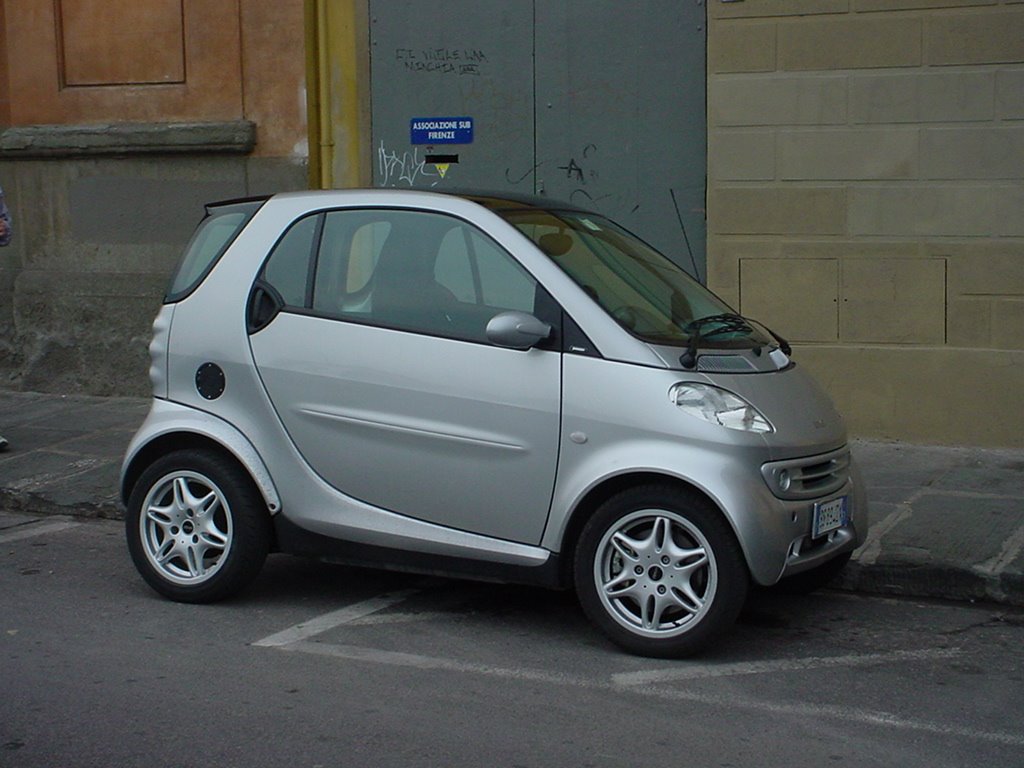 Behold, the smart car. Literally. The Smart gets 60 mpg with a 60-horse engine. This isn't the car for the Grand Prix or the inside lane on the Interstate, the Autobahn or the Autostrada, but for getting around town, this is the car I want next. Unfortunately, you can't get them in the U.S. This photo was taken in Florence, Italy, in 2002.
Wednesday, April 26, 2006
driving under the influence of gasoline
To paraphrase the colonel in Apocalypse Now, we Americans love the smell of gasoline in the morning. Even with gas prices hitting $3.00 per gallon, we will not change our driving habits. I drive to work and home daily on a stretch of Interstate highway, and I generally poke along at 60 to 65 m.p.h. We have three lanes each way which is good. I can stay in the middle lane while the drivers practicing for the Grand Prix in their Hummers, big SUVs and pick-up trucks fly by in the inside lane. Some of them talk on their cell phones, probably griping about the price of gasoline.
There's an easy way to fight high gasoline prices: Slow down. The people who run the Edmunds.com web site studied various techniques that are often suggested to improve your gas mileage. They found that some of the suggestions actually will make a difference: Accelerate moderately, not like a jack rabbit (improves mileage about 30 percent or better), drive the speed limit (saves about 12 percent on average), and use cruise control on the open road, if you have it (about 7 percent). That's about a 50 percent savings. That effectively cuts the price of gas in half. If I sold gas at $1.50/gallon, do you suppose a line would form at the pumps? Sheesh - there would be a riot.
A few years ago I spent a lot of time on the road between home and the east coast of Florida. I discovered a cheap (free) way to make a long trip at a slower speed not merely tolerable but fun. Go to the library and pick up a book on tape, or CD, and let somebody read to you while you drive. I would cross the peninsula on S.R. 70 and watch the cows fly by at 70 m.p.h. (OK, gas was cheaper then) while listening to the reader. At the moment I am listening to the unabridged edition of Dracula, the book, not a sound track from a movie. On the relatively short drive to work it makes me want to slow down so I can hear more of what's coming next.
The only disadvantage is that other drivers are beginning to look like vampires, but I know the fast ones prefer gasoline over blood.
Friday, April 14, 2006

Thursday, April 13, 2006
why wait for trouble. . .
 Air Force General Chuck Yaeger was the star of TV commercials for an auto parts store some years back. After extolling the virtues of replacing old auto parts, he looked the camera squarely in the eye and asked, "Why wait for trouble to come to you?"
I can tell you why some of us do it. Laziness. Inertia. Procrastination. "I'll get it checked out on Friday," you say, and a month of Fridays goes by.
See this tire? I've been driving on it, in this condition, for at least two months. It made a rumbling sound that was noticeably worse driving back from Jacksonville in February.
I drive the Interstate twice a day, five days a week. The noise got worse. I finally dropped by my garage earlier this week. "You will be shocked when you see it," the man said. I was shocked. The missing tread was on the "inside," hard to see if you don't have the right angle, impossible to see if you don't get down and look. There isn't much below that exposed belt except a thin layer of rubber and a whole lot of compressed air.
As the man said, it could have blown sitting still.
There's no doubt in my mind that God watches over me behind the wheel, and this is just one more example.
Moral of the story: If it sounds wrong, feels wrong, or smells wrong, it's wrong. Get it fixed. Do it now.
Wednesday, March 15, 2006
music, music, music
I was given an iPod as a birthday present last year and it is a truly great toy.
Mine is the 6-gig capacity model, just before they came out with the skinny model. I've been haunting public libraries in the county, checking out CD's so I can "rip" songs from them. I've actually bought some from iTunes, too. One of my daughter sent me a CD with some of her favorites on it. Right now I've got something like 1,100 songs in mu iPod, more or less, not counting 101 FM radio frequencies that iTrip uses, and it is barely half full.
I've collected an amazing variety of songs - rock, blues, jazz generally, Dixieland, Cajun, country, Christmas, folk, inspirational, and even bagpipes.
Now, the question facing me is, what kind of music do I really like? I like most of the songs my daughter sent me even though they are new to me. I still like most but not all of the rock 'n roll "oldies." I have too much country, not enough Dixieland.
My music tastes reflect a life spent listening to radio starting back in the late 50's, when the hits of the day were from Rosemary Clooney and Tennessee Ernie Ford. . . speaking of whom, "16 Tons" is in my iPod (but not Clooney's "This Old House"). Music on the radio evolved from that kind of stuff to early rock to Elvis to the Beatles, the hair bands of the 60's, and from there. . . I lost track of it. The DJ's rarely announced the artist or the song title, and the social groups I ran with didn't spend the day talking about the hits. I'm surprised at how much of the music of the 80's I like, because at the time I thought most of it was dreadful.
I learned one lesson a few weeks ago - when you are getting drowsy behind the wheel, put on some bagpipe music and turn it up. It is impossible to fall asleep when a band is playing Highland music.
I've also begun to reach this conclusion: My favorite genre is the blues, and my favorite artist is B.B. King. I picked up some blues songs going back into the 1940's, and let me tell you, those old boys knew the score. Between the singing and the black-key piano playing and the harmonicas, I gotta hear more.
Monday, March 13, 2006
house update
OK, OK, it's been awhile since the last report. We aren't done with the house, yet. We've painted the walls, but going around to do the bottom 18 inches (down below ground level) was a bear 'cause I wanted to do it right -- clean off grunge and mold and flaking paint before slapping more paint on top. That part's done, finally.
Now I'm doing the top six inches, which takes longer than it ought because you paint a few feet, move the ladder, paint a few feet, move the ladder, get a drink, go to the potty, paint a few feet, move the ladder, check on the Florida-South Carolina basketball score. . . time creeps by on the feet of a gazelle and it's too dark to see what you're painting when it seems like you hardly started. My father taught me the job's not done until the tools are cleaned and put away, so there's another half an hour.
We do have a purple door, and it looks better than I expected. I'll post a photo here, one of these days.
Subscribe to:
Posts (Atom)